


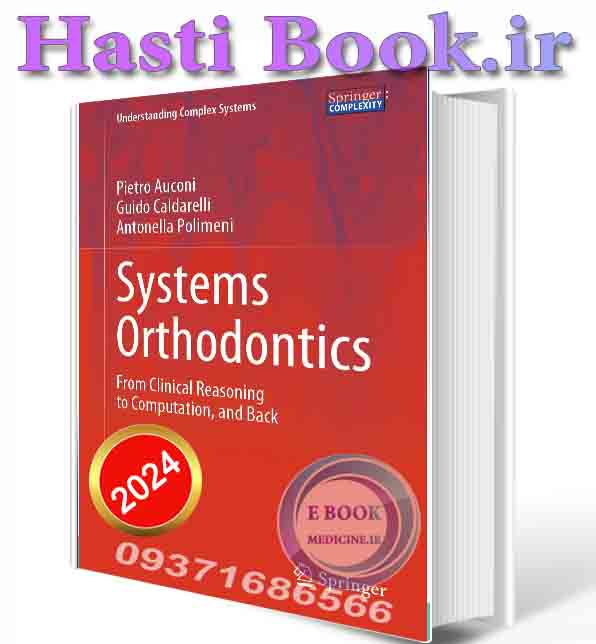
دانلود کتاب Systems Orthodontics: From Clinical Reasoning to Computation, and Back (Understanding Complex Systems) 2025 (ORIGINAL PDF)
نام کتاب:Systems Orthodontics: From Clinical Reasoning to Computation, and Back (Understanding Complex Systems)
نويسنده/نويسندگان: Pietro Auconi (Author), Guido Caldarelli (Author), Antonella Polimeni
نوع فايل: pdf ORIGINAL
سال انتشار: 2024
تعداد صفحات : 169
ناشر : Springer
شابک :9783031649318
نسخه چاپی تمام رنگی ، با کیفیت بالا ،جلد هارد
*بهترین کیفیت افست را از ما بخواهید*
شماره تماس ، واتس آپ و تلگرام 📞 09371686566📞
To buy in dollars, if you have PayPal, send a message to our Telegram
+989371686566
شماره تماس ، واتس آپ و تلگرام 📞 09371686566📞
🌸🌸🌸 🌸🌸🌸 🌸🌸🌸 🌸🌸🌸 🌸🌸🌸🌸
This book marks one of the first applications of the Medicine Network discipline to an everyday scenario. It explores situations where patients, often in adolescence, grapple with the decision of whether to commence a treatment, seeking insights into the more plausible future scenarios. Additionally, the specific feedback from biological systems in the human body serves as a potent metaphor for addressing various challenges in the field of Complex Systems.
In recent times, systems thinking and complexity theory have yielded substantial conceptual advancements across various research domains. In the context of orthodontics, these approaches offer a more comprehensive understanding in contrast to the traditional mechanistic approach, which primarily focuses on the analysis of applied forces. Systems thinking directs attention to the interaction among dentoskeletal components, where the behavior of one element can influence others. The amalgamation of multiple elements leads to entities with properties distinct from those of individual components. The increasing complexity of orthodontic reality beyond clinical or radiological observations necessitates the development of new theories.
Complexity theory has demonstrated that emergent properties in biological systems can be discerned through appropriate computational models, as opposed to the analytical study of individual components. The central metaphor for the interactive craniofacial system during growth is portrayed by the facial topology revealed through network analysis, facilitating a systemic reevaluation of traditional orthodontic theories. This book delineates the novel insights derived from the clinical-computational approach, applicable for a prognostic and early interception perspective in managing dentofacial dysmorphoses. Its objective is to captivate practitioners and persuade them of the practical utility of these innovative approaches.
.